The AC Ace
The Ace is the car that made AC's name and, in time, became the Cobra. This archive covers its sister coupé, the Aceca, in depth. This is the roadster's own story, and how the two relate.
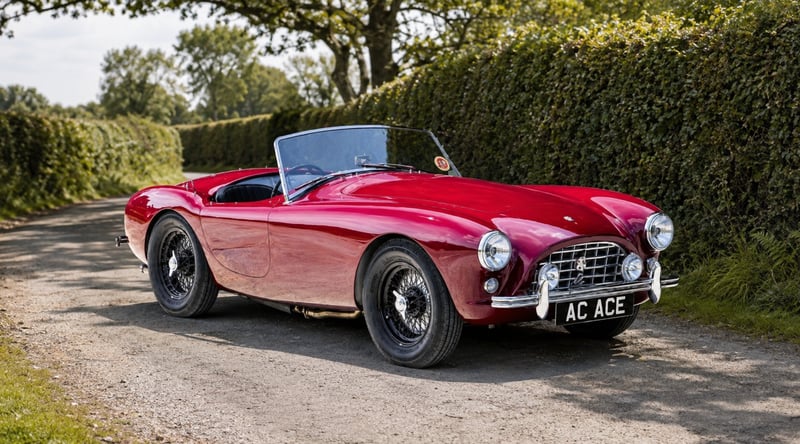
What the AC Ace is
The AC Ace (1953 to 1963) is a hand-built open two-seat sports car from AC Cars of Thames Ditton, on John Tojeiro's lightweight twin-tube ladder chassis with all-independent suspension by transverse leaf springs, advanced for its day, clothed in hand-formed aluminium panels over a small steel-tube superstructure. Its barchetta lines are often likened to the Ferrari 166 MM. Around 720 were built across its ten-year life. It is the sporting, elemental AC of the period, and the direct ancestor of the AC Cobra.
The same architecture as the Aceca
Mechanically, the Ace and the Aceca (AC's fixed-head coupé, from 1954) are closely related cars: the Aceca uses a strengthened version of the Ace's chassis, with heavier-gauge main tubes, an extra cross member, different suspension towers and a rubber-mounted differential, while retaining the same engines and suspension layout. Where they differ is body and character, the Ace an open roadster, the Aceca a refined grand-touring coupé. On the scales the Ace comes in at about 870 kg against the Aceca's 960 kg (approximate kerb weights; hand-built cars and sources vary).
Three engines
Over its life the Ace used the same three power units as the Aceca, set out side by side on the Ace variants page:
- The AC Light Six (2.0): AC's own single-overhead-cam alloy-block six, first designed by John Weller back in 1919. Charming and long-lived, but an old design, roughly 85 to 105 bhp depending on tune, enough for a 1954 Ace to reach about 103 mph, though never truly sporting.
- The Bristol 2.0: from 1956, the pivotal upgrade, Bristol's BMW 328-derived straight-six with three downdraught carburettors, up to around 125 bhp, lifting top speed comfortably over 110 mph. The engine most enthusiasts prize.
- The Ford 2.6 "Ruddspeed": from 1961, after Bristol wound down engine supply, a Ford Zephyr six tuned by Ken Rudd, in stages up to a mighty 170 bhp and around 130 mph. Few were made, but it pointed the way to the Cobra.
A racing thoroughbred
The Ace made AC's name in period competition: a class win at Le Mans in the late 1950s (the Ace-Bristol taking two-litre GT honours) and repeated success in American SCCA club racing, where it dominated its class. Light weight, the Tojeiro chassis and famously delicate steering made it a giant-killer.
From Ace to Cobra
The Ace's most famous chapter came at its end. When Bristol stopped supplying its engine in 1961, the door opened for something bigger: in 1962 Carroll Shelby persuaded AC to drop a Ford V8 into the Ace's chassis, creating the AC Cobra. The lower, longer nose developed for the Ford-engined 2.6 Ace fed directly into the Cobra's look. The Cobra is why the Ace is the famous, and most valuable, AC of the era.
Rarity and values
Around 720 Aces were built (roughly 220 with the AC engine, about 460 with the Bristol, and 37 with the Ford 2.6) against just 328 Acecas. The Cobra connection makes good Aces highly sought-after, the Ace-Bristol especially. Recorded auction results and price-guide figures are collected on the Ace values page. Values move, so check current guides and recent sales. This is general information, not financial advice.
Ace or Aceca?
Same mechanical thoroughbred, two characters: the Ace for open-air purity and the Cobra bloodline; the Aceca for rarity, refinement and the pioneering hatchback. If you're weighing one against the other, see the full Ace vs Aceca comparison.
Frequently asked questions
What is the AC Ace?
Did the AC Ace become the Cobra?
How many AC Aces were built?
What is the difference between the AC Ace and the Aceca?

About the author
A lifelong classic-car enthusiast in North Yorkshire, near Thornton-le-Dale, who owns and maintains an AC Aceca, writing the single-model reference he always wished existed. Read the full bio.