Aceca History:
1954 to 1963
This is the story of the car and of the company that made it: AC Cars at Thames Ditton, John Tojeiro's chassis, the launch at Earls Court in October 1954, the Bristol years, the Ford-engined 2.6, and the Cobra that ended the line in 1963. For the car itself, see the AC Aceca home page.
A marque older than the motor show
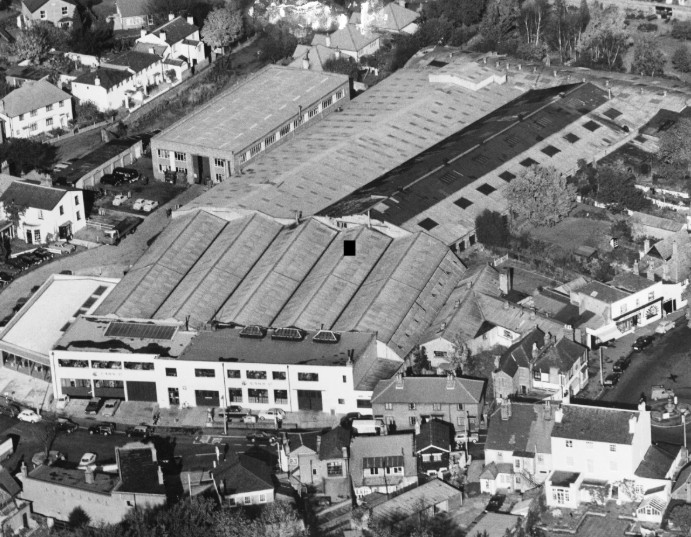
AC Cars, the maker of the Aceca, traces its roots decades before the coupé existed, to the Weller brothers of West Norwood, London, and to a three-wheeled delivery van built in 1904 with backing from a local butcher named John Portwine. John Weller himself was a gifted engineer and prolific inventor who, in 1903, had unveiled an advanced 20 hp touring car at the Crystal Palace Motor Show to warm praise from the motoring press. Portwine judged that car too costly to build and steered Weller instead toward something humbler and more saleable: a small motorised three-wheeled tradesman's carrier. Launched in 1904, the "Auto-Carrier" was a genuine commercial hit, adopted by firms across Britain and beyond. A passenger version, the Sociable, followed in 1907, and it was around this time that the initials "AC" first appeared. In 1911 the firm became Auto Carriers Ltd and moved to the Ferry Works at Thames Ditton, Surrey, a riverside town that would remain the company's home for more than seventy years.
After the First World War, John Weller designed the engine that would, extraordinarily, still be powering AC's cars four decades later: an advanced overhead-camshaft aluminium straight-six, running by 1919 and built, with continuous development, until 1963. It is among the longest-lived production engines ever made. Through the 1920s, under the flamboyant direction of former Napier man Selwyn Edge, AC built a sporting reputation, a light car was first to cover 100 miles in an hour at Brooklands in 1922, and a six-cylinder AC won the Monte Carlo Rally in 1926.
Then came the Depression. AC was forced into liquidation around 1929 to 30, and the company was bought by the Hurlock family, William and Charles Hurlock, who ran a successful haulage and machinery business and initially wanted the Thames Ditton premises chiefly as a warehouse. The car side survived almost by accident: the service department was still viable, there was a stock of parts and part-finished cars, and the Hurlocks, sensing an opportunity, quietly restarted limited production. The family would control AC for the next fifty-six years. It is worth remembering that in the post-war years the glamorous sports cars were not what kept the lights on, a government-backed programme building single-seat invalid carriages provided AC's steady income for decades, subsidising the far more romantic machinery being built alongside it.
The spark: a backyard genius and a car called LOY 500
The AC Aceca's chassis originated not in the AC boardroom but in a small workshop behind an accident-repair shop in Cambridgeshire, belonging to an amateur racer and self-taught engineer named John Tojeiro, whose simple, light twin-tube ladder-frame with all-independent suspension by double wishbones and transverse leaf springs handled beautifully on the rough road surfaces of the day. Tojeiro was building his own sports-racing "specials," and that chassis idea was his key contribution.
“Money was secondary; the main thing was to enjoy myself.”
In 1953, the flamboyant London motor dealer and talented club racer Cliff Davis commissioned Tojeiro to build a chassis to accept a potent two-litre Bristol engine. Clothed by Panelcraft in a hand-formed aluminium body that closely echoed the Ferrari 166 MM "barchetta," the result was registered LOY 500, and it was a sensation, dominating British two-litre racing through 1953 and becoming one of the most photographed cars of the season. That barchetta silhouette, born of a copied Ferrari and a Cambridgeshire shed, is the shape you still recognise in every Ace, every Aceca, and every Cobra that followed.
The link to AC came through Ernie Bailey of Buckland Bodyworks, who already supplied bodies to AC and suggested the Hurlocks take a look at what Tojeiro was doing. Here the popular story is often simplified. LOY 500 was the car that captured AC's attention, but the car AC actually acquired was a later Tojeiro barchetta, Vin Davison's Lea-Francis-powered LER 371. Fitted with AC's own six-cylinder engine, repainted blue and re-registered TPL 792, it became the AC Ace prototype. For his design and for brokering the deal, Tojeiro received a royalty of just £5 per car, and only on the first hundred sold, a modest reward for shaping one of the most significant British sports cars of the century.
The Ace, then the Aceca
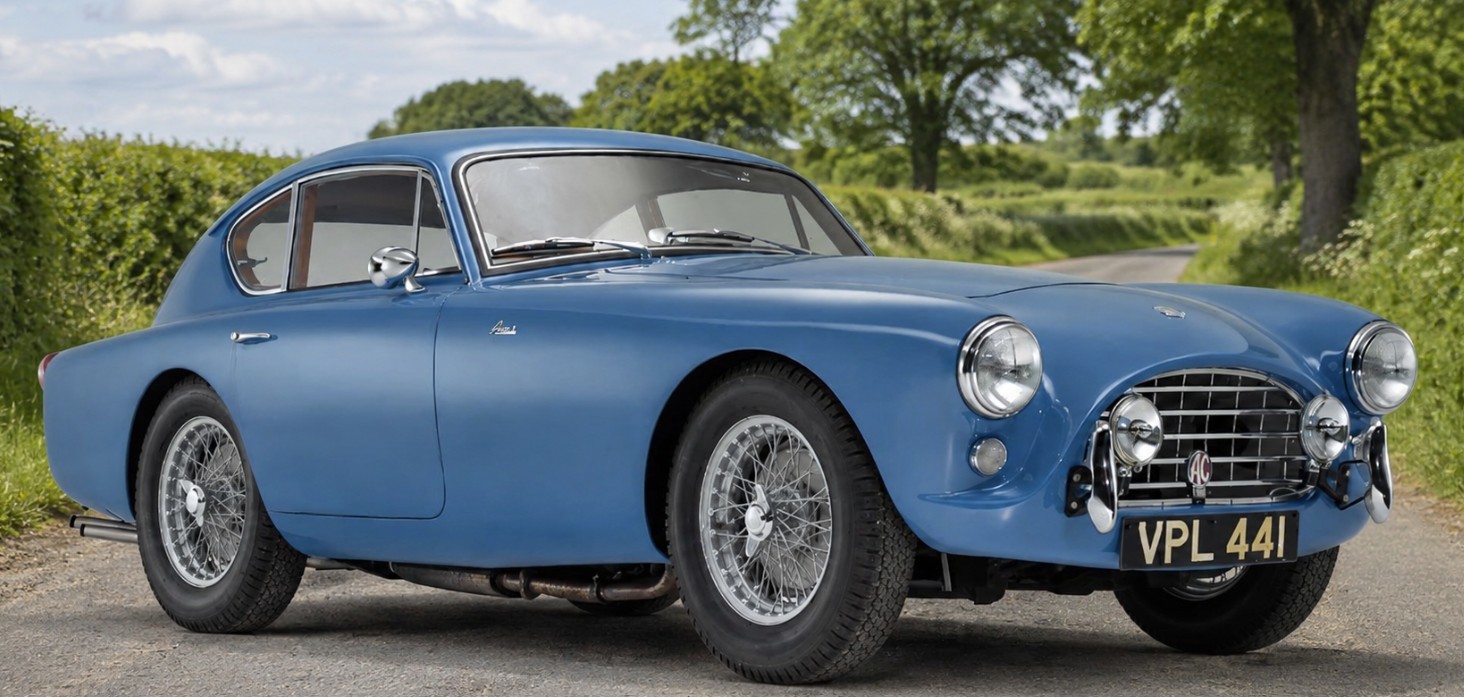
The AC Aceca was announced in October 1954 as the fixed-head coupé sister to the AC Ace roadster, built on the same running gear. The Ace itself had been unveiled at the 1953 London Motor Show at Earls Court, its lines subtly smoothed from the raw Tojeiro barchetta into something sleeker and more graceful; production prototypes were running by spring 1954, and the first customer Aces were delivered that May.
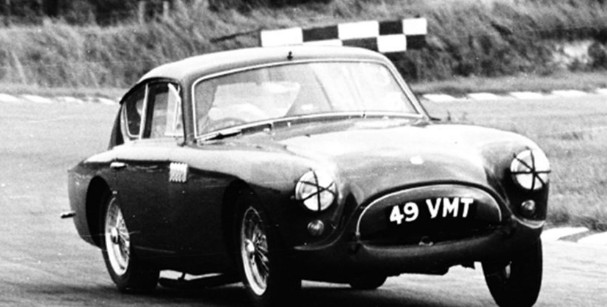
The Aceca was more than an Ace with a roof. It was a genuine grand tourer, more luxuriously trimmed and better insulated, with fibreglass mouldings used for the bulkheads and footwells to quieten the cabin. Its most celebrated feature sat at the back: an elegant fastback roofline sweeping down to a lift-up rear tailgate over a proper luggage compartment. This made the Aceca only the second production car in the world, after the 1953 Aston Martin DB2/4, to feature what we would now call a hatchback. Inside were leather bucket seats, a full complement of instruments, and burr-walnut dashboard inserts, craftsmanship over mass appeal.
“Only the second production car ever, after the Aston Martin DB2/4, to feature a hatchback.”
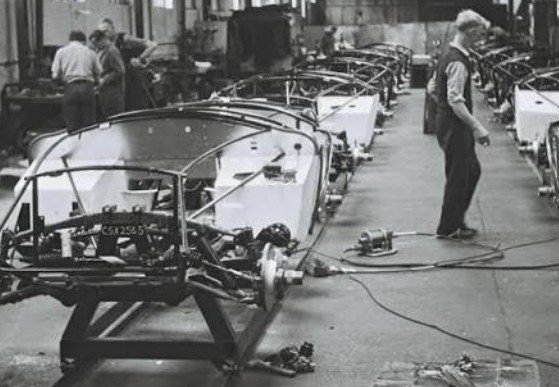
Beneath the hand-formed aluminium skin lay a traditional structure of ash timber framing over the tubular steel chassis, the panels shaped by hand on an English wheeling machine. The car was light, around 895 kg, with near 50/50 weight distribution and large 16-inch wire wheels, and it handled with a delicacy that belied its modest power. The very first Aceca, the 1954 prototype registered VPL 441, was later used by the land- and water-speed-record legend Donald Campbell, who had it painted in the leftover "Bluebird Blue" from his K7 hydroplane; during his ownership its AC engine was replaced by a Bristol unit. After decades of neglect it was rescued, meticulously restored, and displayed at the Lakeland Motor Museum.
Three engines, one silhouette
Across its life the Aceca was offered with three quite different straight-sixes, and the chassis prefix on each car tells you which: AE for the AC engine, BE for Bristol, RS for the Ford unit, with an added X (AEX, BEX, RSX) marking an export car.
The original Aceca used AC's own Weller-designed Light Six, the very engine conceived in 1919: 1,991 cc, with an aluminium block and cast-iron head, producing roughly 85 to 105 bhp over its life and giving a top speed around 103 mph. Charming, torquey and characterful, it was nonetheless a pre-war design nearing the end of its potential.
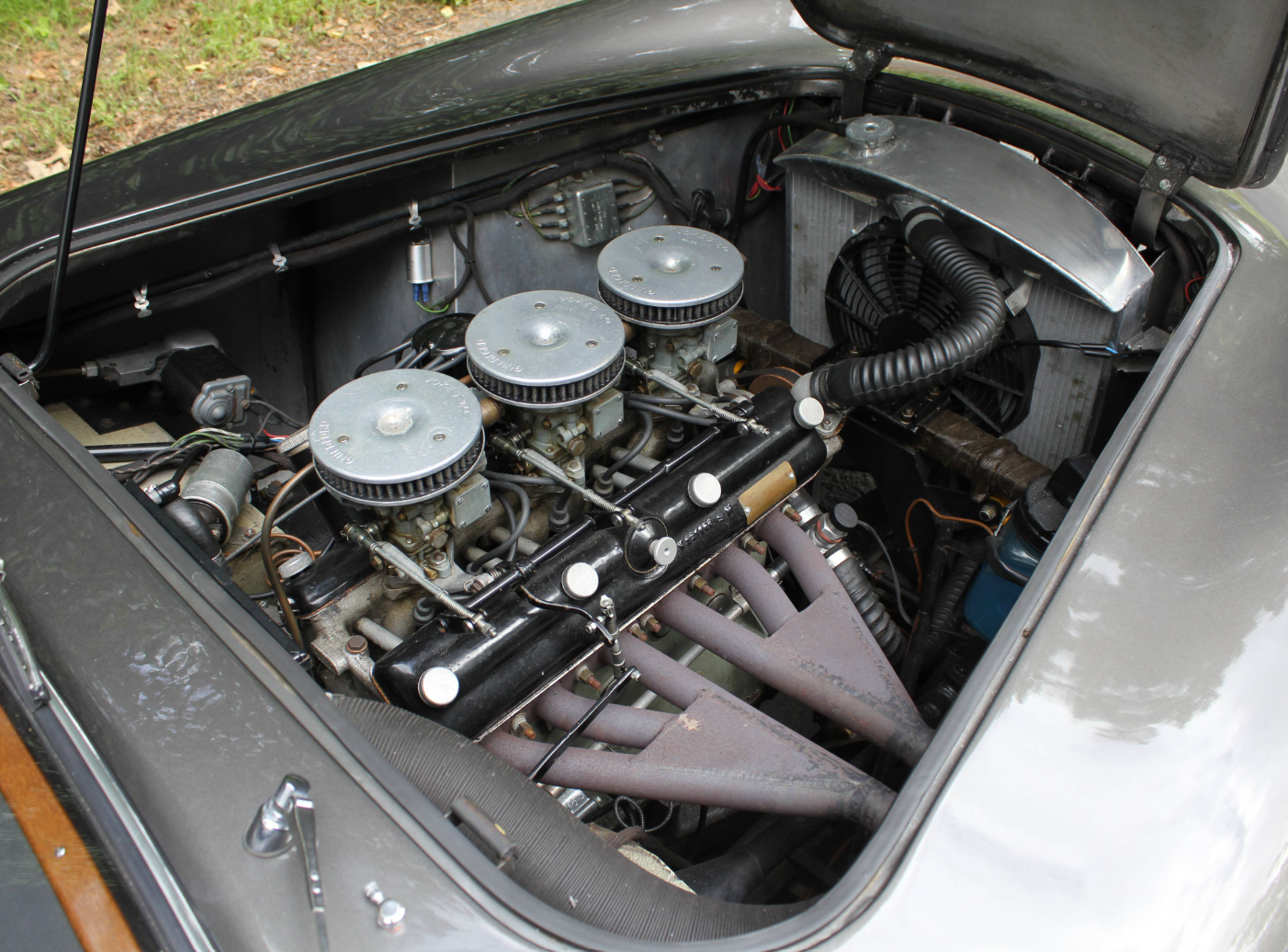
From 1956 came the car most enthusiasts prize, the Aceca-Bristol. Its 1,971 cc engine was descended from the pre-war BMW 328, a design that passed to Britain in the aftermath of the Second World War, and it transformed the car. It carried a cast-iron block, an aluminium cross-flow cylinder head with hemispherical combustion chambers, a nitrided crankshaft and forged connecting rods, and it breathed through three downdraught carburettors. Its most fascinating quirk is the valvetrain: the camshaft sits low in the block, yet the exhaust valves are worked by long transverse pushrods running right across the top of the engine, so that it looks, deceptively, like a twin-cam. Outputs ran from about 105 bhp to around 128 bhp on the road, and up to roughly 150 bhp in full race tune, lifting top speed to 116 to 128 mph and cutting the 0-60 mph sprint into the nine-second bracket.
Finally, from 1961, a handful of cars received the Aceca 2.6's engine: a 2,553 cc Ford Zephyr six, extensively reworked by Ken Rudd's Ruddspeed concern with triple carburettors and, in the hottest states of tune, as much as 170 bhp, good for around 130 mph. Only eight Acecas were built this way, making it comfortably the rarest of the three.
Proving it on the track
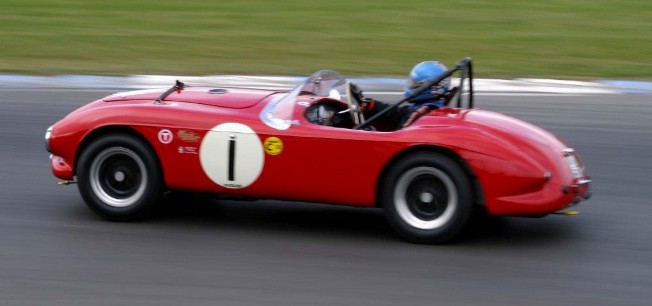
The Bristol engine turned the AC Ace and Aceca into race winners, not just faster cars. In April 1956 the engineer and racer Ken Rudd took his Bristol-engined Ace to the Goodwood Easter meeting and won convincingly against a field that included far more exotic machinery, a result that helped establish the Bristol option and launched a distinguished competition record. The open Ace was the marque's Le Mans weapon: an Ace-Bristol finished 10th overall and second in the two-litre class at the 1957 Le Mans 24 Hours, and went one better in 1958 with 8th overall and another class result. In the United States, the cars became a force in SCCA production racing. The Aceca coupé shared all of this mechanical DNA and appeared regularly in rallies and races of its own, its closed body making it a quieter, more usable long-distance companion.
A question of rarity
Just 328 AC Acecas were built in total when production ended in 1963, 151 with the AC engine, 169 with the Bristol engine, and just 8 with the Ford unit, a figure astonishingly small by any modern measure, because AC was never a volume manufacturer. Some published sources quote slightly different totals. You will see figures around 300, 326 or 328, and survivor counts are necessarily estimates, because records for a hand-built car of this era are incomplete. What is not in doubt is that the great majority of AC's Ace and Aceca output was exported, chiefly to the United States, where the cars found an enthusiastic audience. New, an Aceca cost roughly £1,500 in Britain, with the Bristol specification lifting the price to around £1,722; in America the figures were about $5,400, and $1,000 more again for the Bristol engine.
The rare and the coachbuilt
A handful of unique Aceca and Ace variants were commissioned outside the AC production line by importers and collectors, creating cars now prized above the standard build. The Swiss AC importer Hubert Patthey had three Aceca-Bristols rebodied by the carrozzeria Ghia-Aigle, with lowered noses and faired-in headlamps. Patthey was also behind a one-off Zagato-bodied Ace-Bristol (chassis BEX 477), which wore the Italian house's trademark "double-bubble" roof and won its class at the 1958 Coupes du Salon. And in 1957 the factory built a single experimental Aceca powered by a Triumph TR3 engine, chassis TAE 618, its "T" prefix denoting the Triumph unit, conceived as a cheaper alternative to the Bristol car; it was later restored on television's Car SOS.
The end, and the legend it left behind
Aceca production ended in 1963 as AC's own Light Six reached the limit of its development and Bristol wound down engine supply, the same moment at which a lean Texan named Carroll Shelby approached AC's Charles Hurlock with an audacious idea that would become the AC Cobra. Bristol agreed to keep building the two-litre for AC until 1963. Shelby's proposal was to drop a compact American Ford V8 into the light, well-balanced Ace chassis. AC agreed. The result, unveiled in 1962, was the AC Cobra, a car that would go on to humble Ferrari and become one of the most revered and most copied sports cars in history. Aceca production drew to a close in 1963, but the essential architecture that John Tojeiro had sketched in a Cambridgeshire shed lived on beneath the Cobra's muscular skin.
Why the Aceca still matters
The AC Aceca still matters because it is the elegant, civilised expression of the same brilliant idea that produced the Cobra, a hand-built British grand tourer of ash and aluminium, blessed with exquisite handling, genuine racing pedigree, and a body shape drawn (however indirectly) from a Ferrari. It is easily overlooked in the shadow of the Cobra, but that is precisely why it rewards attention. Fewer than 330 were ever made. Every survivor is a piece of the story that runs from a butcher's delivery van, through a backyard racing special, to one of the greatest sports cars the world has known. This site exists to record them.

About the author
A lifelong classic-car enthusiast in North Yorkshire, near Thornton-le-Dale, who owns and maintains an AC Aceca, writing the single-model reference he always wished existed. Read the full bio.