Thames Ditton
and the AC works
Every car this archive exists for was hand-built in one Surrey riverside town. AC Cars occupied the Ferry Works at Thames Ditton from October 1911 for more than seventy years, and the Aceca, its Ace sister and the Cobra that followed all came out of it. This is the story of the place, told from the sources, with the disagreements between them left in.
Before Thames Ditton
The company that became AC began as Weller Brothers, formed in 1899 at West Norwood in south London, building self-propelled cars and tradesmen's carriers. In 1903 the Wellers showed an ambitious four-wheeled car, the Weller 20hp, at the Crystal Palace Motor Show, where The Autocar predicted a brilliant future for it. John Portwine, a butcher and the venture's financial backer, judged the 20hp too expensive to produce and encouraged John Weller to design something smaller.
What Weller produced instead was the Auto-Carrier, a three-wheeled delivery vehicle with tiller steering. Autocars and Accessories was founded in 1904 and production began that year; the little carrier sold worldwide across a diverse model range. A passenger version, the AC Sociable, appeared in 1907 with a seat in place of the cargo box. In November 1907, according to AC's own records, the abbreviation AC was used for the first time, and the company became Autocarriers Ltd.
The move, October 1911
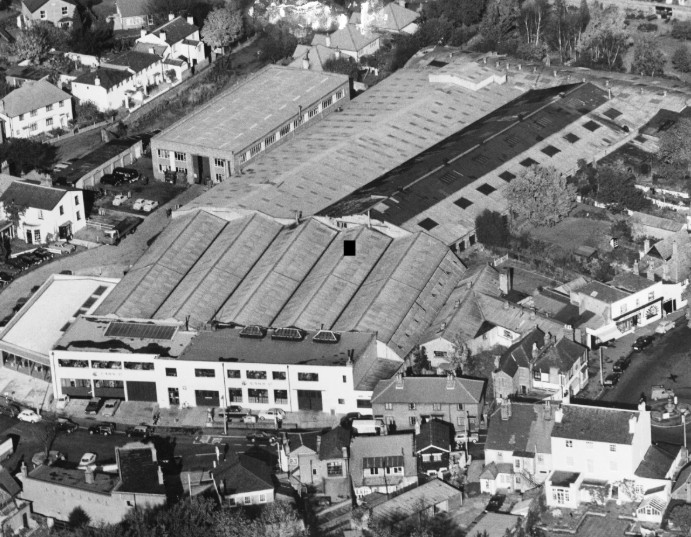
Running out of space at West Norwood, Weller and Portwine moved the business in October 1911 to a large factory at Thames Ditton, Surrey: the Ferry Works, previously occupied by Willans and Robinson, marine and later electrical engineers. The building carried its own history. Much of it had been destroyed by fire in 1886, and it is recorded of the factory rebuilt on more modern lines that it was the first in the world to be lit entirely by electricity, a claim repeated in the building's histories rather than one we can independently establish.
With the move the company was renamed Autocarriers (1911) Ltd, though the name AC was already being used on the cars themselves. The new home sat a short distance from Brooklands, the banked motor circuit where the marque would soon make its sporting name.
What was built there
The Auto-Carrier and the Tricar, the vehicles that had made the company, continued at Thames Ditton for a further three years. In 1913 AC produced its first four-wheeled vehicle, the AC Light Car, designed by Weller and making extensive use of aluminium castings to keep weight down, with Fivet engines of 10hp and 12hp. During the First World War the Ferry Works turned to the war effort, producing shells, fuses, munitions and aircraft parts.
In 1919 AC expanded onto a second site in Thames Ditton's High Street, and here the sources disagree. One records the purchase of the site of the former High House, on which a factory was built; another describes expansion into an old balloon factory on the High Street. We report both rather than choose between them.
The Weller engine
The development that matters most on this site came out of John Weller's spare time. During the war he developed his own two-litre, six-cylinder, overhead-camshaft engine, announced in October 1919, just before the Olympia Motor Show, where it was praised for its elegance and innovation.
That engine remained in production until 1963, a run of more than four decades. It is often described as possibly the second longest-lived production engine in history, after the Volkswagen flat-four; we repeat the claim as it is usually made, rather than as settled fact. It is the engine that powers the AC-engined Aceca, and its full technical story is told on our AC Light Six page.
The years between
In 1921 Selwyn Edge, formerly of Napier, bought shares in the company and was appointed governing director. He did not get on with Weller or Portwine, who resigned less than a year later. The sporting reputation grew anyway: in 1922 J A Joyce, driving an AC at Brooklands, made it the first light car to cover 100 miles in the hour, and in 1926 the Hon Victor Bruce won the Monte Carlo Rally in a six-cylinder AC.
In 1930 the Hurlock family bought the company, and the lease on the Ferry Works lapsed, a turn of events recorded by the AC Owners Club and the Thames Ditton and Weston Green Residents' Association. The family would control AC for decades to come.
The Ace, the Aceca and what followed
In 1952 John Tojeiro's sports racing car formed the basis of the alloy-bodied Ace, introduced in 1953 with the Weller engine still under the bonnet. The Aceca followed as its closed sister, and the four-seater Greyhound after that, with the Bristol engine offered from 1956 and the Ford unit from 1961. The Cobra derivative of the Ace arrived in 1962. Each of these cars was built at Thames Ditton; their individual stories are told on the variant pages and in the full model history.
The end
AC remained at Thames Ditton for over seventy years. The factory was sold for redevelopment in 1986, closing a chapter that had begun with a three-wheeled delivery van at West Norwood in 1904. The cars that left those gates, the Auto-Carriers and Tricars, the light cars, the six-cylinder tourers, and finally the Ace, Aceca and Cobra, were all shaped by one small Surrey town and the people who worked in it.
Frequently asked questions
Where were AC Acecas built?
When did AC move to Thames Ditton?
What was the Ferry Works?
How long was AC at Thames Ditton?
What happened to the AC factory at Thames Ditton?

About the author
A lifelong classic-car enthusiast in North Yorkshire, near Thornton-le-Dale, who owns and maintains an AC Aceca, writing the single-model reference he always wished existed. Read the full bio.