The AC Greyhound:
A Four-Seater Grand Tourer
The AC Greyhound was AC Cars' answer to a persistent question from Aceca customers, where do the children sit? Launched at the 1959 Earls Court Motor Show, it was a full four-seater grand tourer built on a longer-wheelbase, coil-sprung chassis, sharing much of its mechanical architecture with the Aceca-Bristol from which it descended.
A Thames Ditton 2+2
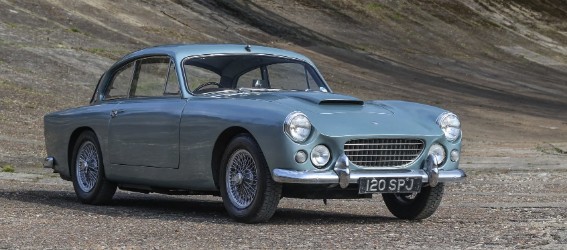
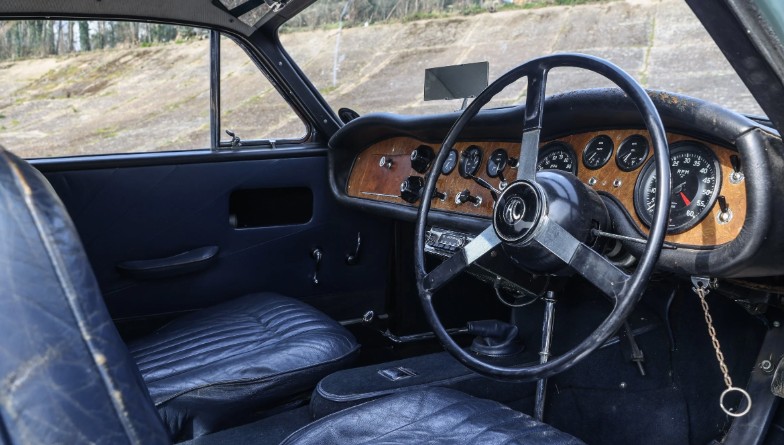
The Greyhound is best understood as the four-seater sibling to the Aceca-Bristol. Built at AC's Thames Ditton works between 1959 and 1963, it shared the hand-formed aluminium-over-tube construction, the Bristol two-litre six as its principal engine, and much of the Aceca's cockpit vocabulary, but it stretched the wheelbase by ten inches and moved to all-round coil-sprung independent suspension. The result was a genuine 2+2 that could carry a family with real luggage at real speed.
Production totalled 82 cars over four years, even rarer than the Aceca-Bristol, and produced in parallel with it. In AC's model hierarchy of the period the Greyhound was the touring car in a range that also included a sports car and a fixed-head coupé.
Shared engines, different chassis
Where the Aceca used a leaf-sprung transverse-leaf front and rear suspension inherited from the AC Ace, the Greyhound was designed from the outset around coil springs and wishbones at all four corners, on a new tubular chassis. It is the first AC road car to break with the leaf-sprung tradition, and it prefigures the coil-sprung architecture that would arrive on the Cobra a few years later.
Under the bonnet the options mirrored the Aceca: most Greyhounds left Thames Ditton with the Bristol 100D2 two-litre six on triple Solex 32 BI carburettors, producing 105 bhp. A handful were built with the AC two-litre unit, and a small number with Ford's 2.6-litre Zephyr six after Bristol ceased engine supply, the same power-unit change that produced the Aceca 2.6.
“The Greyhound is an Aceca-Bristol that grew up, moved to the country, and learned to carry passengers.”
Bodywork by AC, styling by Zagato, briefly
The Greyhound's body was designed and built in-house at Thames Ditton, formed in aluminium over a light steel superstructure in the AC tradition. An early proposal from Carrozzeria Zagato was considered and abandoned, and the production shape, with its long roofline, fastback rear and Aceca-derived nose, is entirely an AC design. Coachwork was fitted by AC's own panel-beaters, one car at a time, in the same shop that built the Aceca.
Why so few?
82 cars over four years is a modest figure by any measure, and the reasons are structural rather than dynamic. The Greyhound was hand-built to Aceca-Bristol standards, at a moment when Jaguar's Mark 2 and the Aston Martin DB4 were also offering four seats. The Greyhound's market was narrow by construction. Add the Bristol engine's disappearance in 1961 and AC's parallel work on the Cobra from 1962, and production was quietly wound down.
Its place in the Aceca story
The Greyhound matters to Aceca history because it is the model AC built when Aceca customers asked for a back seat. Every drivetrain change on the Greyhound, Bristol to AC to Ford, mirrored a change on the Aceca; every suspension experiment on the Greyhound pointed forward to what AC would do next. Reading the two model histories side by side is the clearest way to see how AC's engineering thinking evolved in the years before the Cobra eclipsed everything else.

About the author
A lifelong classic-car enthusiast in North Yorkshire, near Thornton-le-Dale, who owns and maintains an AC Aceca, writing the single-model reference he always wished existed. Read the full bio.