The Bristol Engine:
A Racing Heart Born in Munich
The engine that transformed the AC Aceca was not designed by AC, nor even in Britain. Its story begins in 1930s Bavaria, runs through one of the most dominant sports cars of the pre-war era, and crosses the Channel as spoils of war. This is how a pre-war BMW came to beat at the heart of a hand-built British grand tourer, and why enthusiasts still prize it.
A clever answer to an expensive problem
The Bristol engine's origins lie in mid-1930s Bavaria, where BMW wanted more performance from its road cars but lacked the budget for an all-new unit. Engine specialist Rudolf Schleicher, working alongside chief engineer Fritz Fiedler, was set a subtler challenge than a costly twin-overhead-camshaft racing design: extract the breathing efficiency of a hemispherical combustion chamber with inclined valves, but without the height, complexity or expense of overhead camshafts, and using the existing cast-iron cylinder block from the humble BMW 326 saloon. The inspiration, the story goes, came at the 1935 Paris motor show, where the engineers studied a French design that hinted at how it might be done.
The result, unveiled in the BMW 328 of 1936, was a small masterpiece of lateral thinking.
The head that fooled the experts
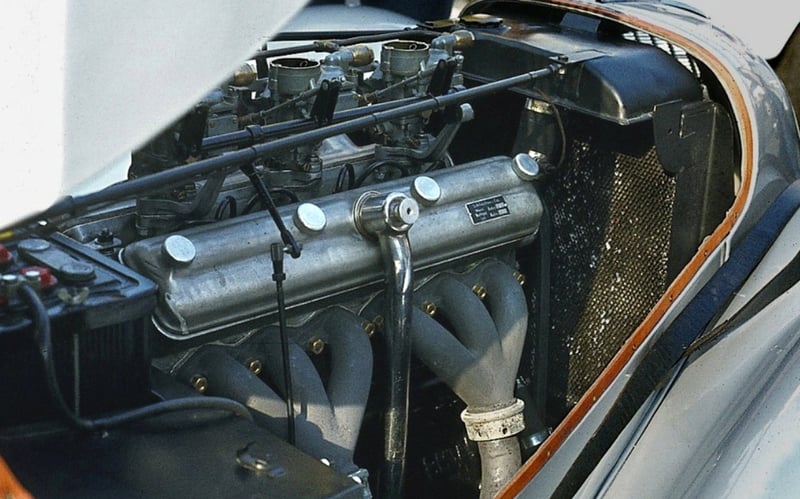
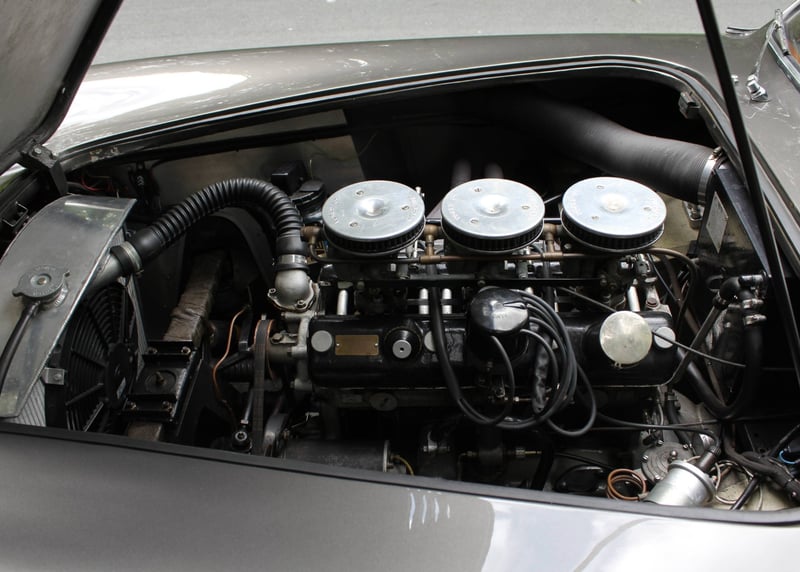
Schleicher's cylinder-head design kept the camshaft low in the block, where it was cheap and simple to drive, and reached the exhaust valves on the far side of a wide combustion chamber by means of long transverse pushrods running straight across the top of the engine to a second rocker shaft. The engine therefore had two rocker covers, one along each side of the head, giving it, to the casual eye, exactly the appearance of a sophisticated twin-cam. The inlet valves, meanwhile, were operated conventionally by pushrods and rockers. It was a look that famously caught people out at motor shows for decades: it seemed like a thoroughbred racing engine, but underneath it was a clever pushrod unit built on a modest saloon-car block. The design was considered advanced enough to be granted a patent in 1939.
“It looked like a twin-cam. It was, in fact, an ingenious pushrod engine in disguise.”
The measure of the thing
The Bristol two-litre six displaced 1,971 cc in its original BMW form, from a bore of 66 mm and a long stroke of 96 mm, dimensions the Bristol-built versions would faithfully retain. It breathed through three downdraught Solex carburettors and produced around 80 horsepower in road tune, a genuinely strong figure for a normally-aspirated two-litre of the period, and enough to make the light BMW 328 quick by any 1930s standard. The 328 was never built in great numbers, only around 460 were made between 1936 and 1940, which only deepened the legend that grew around it.
Dominance on the track
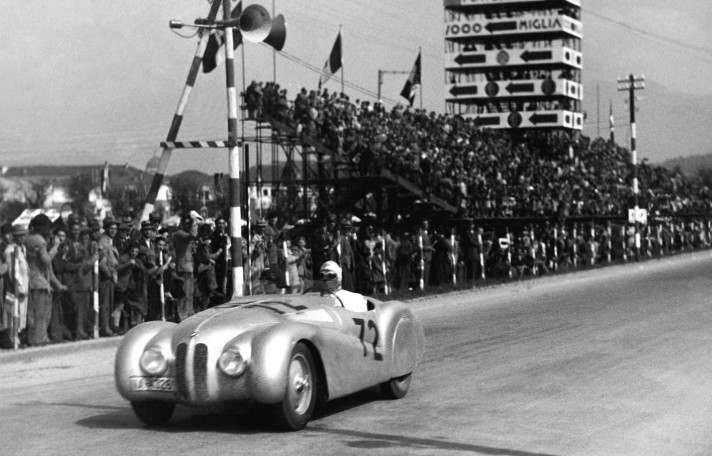
The BMW 328, the car in which the Bristol engine's ancestor first appeared, announced itself immediately, winning its class on competition debut at the Eifelrennen at the Nürburgring in June 1936 and going on to a period of near-total dominance in two-litre sports-car racing. The model amassed well over a hundred class victories before the war, including class wins at the Mille Miglia, the RAC Tourist Trophy, the Spa 24 Hours, and the Le Mans 24 Hours, where in 1939 a 328 took its class and finished fifth overall. In 1940 a specially streamlined coupé won a shortened Mille Miglia outright. Crucially for our story, the car had a British following: the London firm AFN Ltd, run by the Aldington brothers, imported right-hand-drive examples and sold them as "Frazer Nash-BMWs." That connection would prove decisive.
The spoils of war
The BMW 328 engine came to Britain as war reparations after 1945, acquired by the Bristol Aeroplane Company, a vast concern that had employed tens of thousands building aircraft and engines and was now looking for a peacetime future in high-quality cars. Through the Aldingtons' long-standing BMW relationship, and with the backing of the War Reparations Board, representatives travelled to the bombed and occupied BMW works in Germany and came away with something remarkable: the manufacturing rights to several pre-war BMW models and, most valuable of all, the design of the 328's two-litre engine. They returned not only with plans but with the man himself, BMW's gifted engineer Dr Fritz Fiedler, who came to England to help lead the engineering effort.
The first fruit was the Bristol 400 of 1947, an unashamed distillation of the best pre-war BMWs: the chassis owed itself to the 326, the body to the 327, the engine to the 328, and even the twin-kidney grille was retained in modified form. Bristol and the Aldingtons soon parted ways, Frazer Nash was sold back and continued as a separate maker, but Bristol kept supplying its BMW-derived engines to Frazer Nash and others for years afterward.
“A pre-war German racing engine, carried to Britain as reparations, became the foundation of a new marque.”
Bristol makes it their own
Bristol did not merely copy the BMW two-litre six; it refined it, applying the metallurgy and build standards of an aircraft manufacturer. Better materials gave the engine greater strength and longevity, and continuous development raised its output through Bristol's own model range. In this refined, Bristol-built form the engine became one of the most admired small sixes in the world, and it powered far more than just Bristol's own cars. Over roughly fifteen years it found its way into Frazer Nash, Cooper, Lotus and Lister racing cars, the Italian-bodied Arnolt-Bristols built for America, and, from 1956, the AC Ace and Aceca.
Who built what? Clearing up the myth
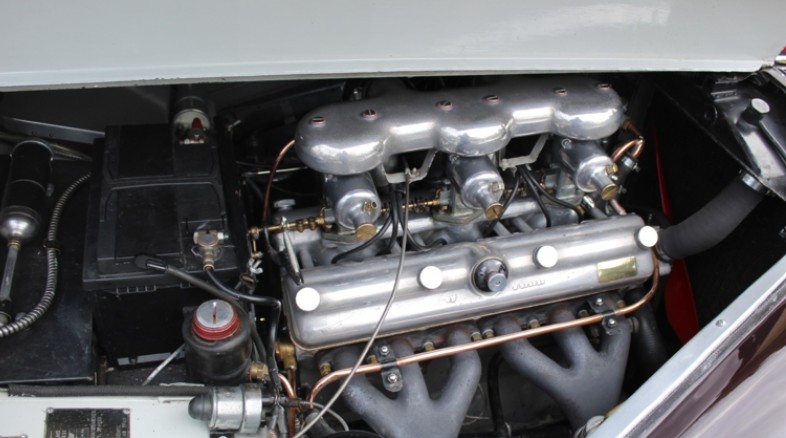
It is worth pausing on a point that trips up even seasoned enthusiasts, because three different companies have their fingerprints on this engine and they are easily muddled. BMW designed it, in 1936. Bristol, strictly the car division of the Bristol Aeroplane Company, and later Bristol Cars in its own right, built and developed it in Britain after the war, to aircraft-grade standards. And AC did neither: AC bought the finished engine and dropped it into the Ace and Aceca. So an 'Aceca-Bristol' is an AC-built car carrying a bought-in, Bristol-built, BMW-derived engine. BMW built none of these engines; AC built none of them either. The three names on the story each belong to a different firm doing a different job.
AC came to the engine almost by accident. The AC agent and racer Ken Rudd, frustrated by the elderly AC Light Six, fitted a Bristol unit to his own Ace in the mid-1950s and promptly started winning. The Hurlock family, who owned AC, took note and struck a deal with Bristol to buy the engine, and its four-speed gearbox, as a factory option from 1956. It suited both sides: Bristol was glad of the extra revenue and the racing exposure, and AC's little sports cars did not compete with Bristol's expensive luxury saloons, so no rivalry got in the way. Bristol-engined cars can be told at a glance by their chassis numbers, which begin 'BE' where an AC-engined car begins 'AE'.
That arrangement was also the Aceca's Achilles heel. Because the engine was bought in rather than AC's own, AC was exposed the moment its supplier changed course, and at the turn of the 1960s Bristol did exactly that, switching its own cars to off-the-shelf Chrysler V8s and winding down the two-litre six. Bristol honoured its commitment and kept supplying AC to around 1963, but AC now had to find a new heart for its cars. The stop-gap was the Ford 2.6 'Ruddspeed'; the legend that followed, when Carroll Shelby proposed a Ford V8 for the AC Ace, was the Cobra. The whole late history of the Ace and Aceca, in other words, turns on the fact that its finest engine was never AC's to keep.
Into the AC Aceca
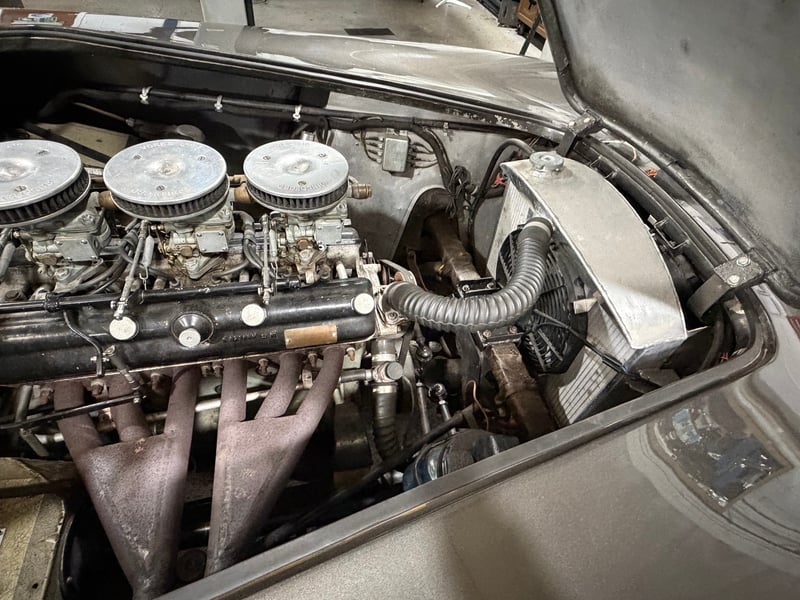
The Bristol engine reached the AC Aceca in 1956, when AC's own venerable Light Six had reached the limit of its development and the Bristol unit was the obvious answer. It dropped into the Ace and Aceca with relatively little difficulty and utterly transformed them. In the Aceca-Bristol the engine was offered in several states of tune, Bristol's Type 100 series, producing anywhere from around 105 brake horsepower in milder form to roughly 125 to 128 bhp, and as much as 150 bhp in full competition specification. Top speed rose to somewhere between 116 and 128 mph depending on tune, and the standing sprint to 60 mph fell into the nine-second bracket. Just as importantly, the engine's competition pedigree turned the Ace and Aceca from pretty, well-handling machines into genuine race-winners, most famously in the hands of Ken Rudd, and in the AC's class successes at Le Mans in the late 1950s. Of the 328 Acecas built, 169 carried this engine, and they are the most coveted of all.
The end of a very long line
The Bristol engine's road-car career drew to a close at the start of the 1960s. In 1961 Bristol itself moved on to larger, off-the-shelf Chrysler V8 power for its own cars, but it agreed to keep building the two-litre six for AC until 1963, which is why the Aceca-Bristol survived to the very end of Aceca production. From a modest 1930s BMW saloon block to a hand-built British grand tourer of the 1960s, the design had enjoyed an extraordinary innings of nearly three decades, spanning two countries, a world war, and some of the finest sports cars either nation ever produced.
Why enthusiasts still love it
Enthusiasts still love the Bristol engine for the sheer improbability of its story, a German racing engine, seized as reparations, reborn in Bristol and Thames Ditton, for the engineering of that ingenious cross-pushrod head, so effective and so convincingly disguised as something far more exotic, and for the way it drives: smooth, free-revving and eager, with a hard-edged competition character that no amount of restoration ever quite civilises. To lift the bonnet of an Aceca-Bristol is to look at a direct descendant of one of the greatest sports-car engines of the pre-war world.

About the author
A lifelong classic-car enthusiast in North Yorkshire, near Thornton-le-Dale, who owns and maintains an AC Aceca, writing the single-model reference he always wished existed. Read the full bio.