The AC-Engined Aceca:
The Original
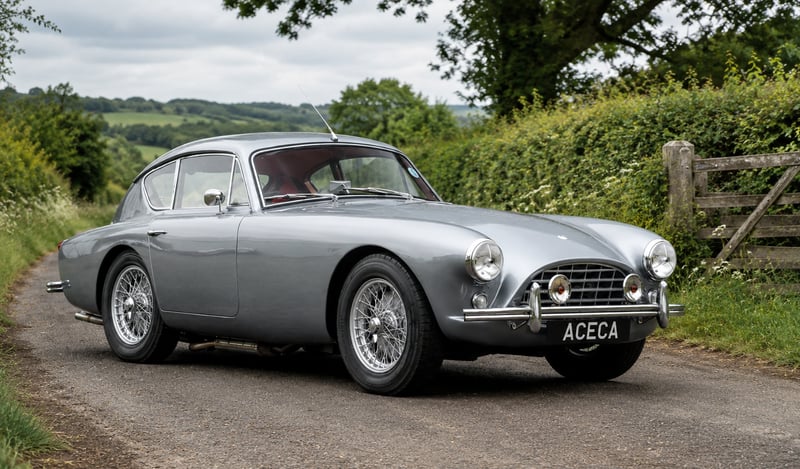
The car that started it all, the first Aceca, powered by AC's own straight-six, a design already three decades old when the coupé was born. 151 were built between 1954 and 1963, and they remain the purest expression of the model.
A coachbuilt coupé on a racing chassis
The original AC Aceca was launched at the Earls Court Motor Show in October 1954, taking the lightweight, all-independent chassis of the AC Ace roadster and clothing it in an elegant fixed-head coupé body of hand-formed aluminium over a small steel-tube superstructure, with ash in the doors and rear hatch. It was more luxurious than the open Ace, better trimmed, better insulated, with fibreglass mouldings quietening the cabin, and it carried the model's signature feature: a fastback roofline sweeping down to a lift-up rear tailgate, making the Aceca only the second production car in the world, after the Aston Martin DB2/4, to feature a hatchback.
The Weller Light Six
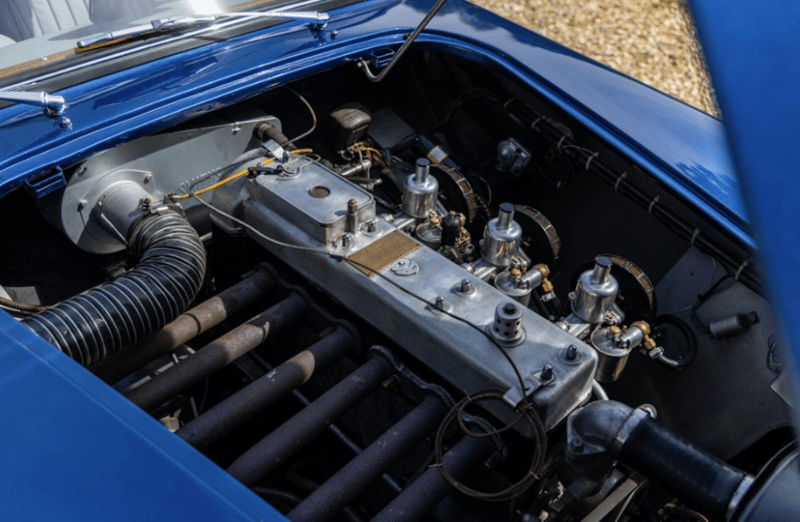
The original AC Aceca is defined by its engine: AC's own Light Six, a 1,991 cc straight-six first designed by company founder John Weller and running as early as 1919, one of the longest-serving production engines in motoring history, built with continuous development until 1963. Its aluminium block and single cam-in-head operating the valves through rockers made it, by the 1950s, a genuinely pre-war design, but a charming and long-lived one. Output ranged from around 85 to 105 brake horsepower across the car's life, with roughly 90 bhp typical, giving a top speed near 103 mph and a 0-60 mph time a little over ten seconds.
“Not the fastest Aceca, but the one with the deepest roots, tracing directly to 1919.”
Continuous refinement
The AC-engined Aceca was steadily improved through production: from 1959, around chassis AEX 1010, AC adopted its higher-compression CLB version of the engine, with a stronger oil pump and a nitrided crankshaft, lifting output to about 102 bhp. Around the same time a lightweight gearbox option appeared, using Triumph TR3 internals in a special alloy casing with a remote change. Front disc brakes, optional from 1957, became standard for 1958, and overdrive was available to make the most of the engine's relaxed, torquey character on a long run.
Identity and rarity
AC-engined cars carry chassis numbers beginning AE, or AEX for left-hand-drive cars, according to the AC Owners' Club. Just 151 were built, fewer than the Bristol-engined cars. For collectors they hold a particular appeal: this is the Aceca with AC's own heart, the model in its original and most characterful form, and the direct link back to the very origins of the marque. Published sources give AC Light Six production as ending in 1961, while this archive's registry holds AC engined cars recorded to 1963; the production page sets out the disagreement.

About the author
A lifelong classic-car enthusiast in North Yorkshire, near Thornton-le-Dale, who owns and maintains an AC Aceca, writing the single-model reference he always wished existed. Read the full bio.