Aceca vs Aston Martin DB2/4
Two beautiful British hatchback coupés, born within a year of each other, and mistaken for one another ever since. Here is how the AC Aceca and the Aston Martin DB2/4 truly compare, fairly, but from the Aceca's corner.
Why they get confused
Park an Aceca beside an Aston Martin DB2/4 and the family resemblance is obvious: two hand-built British grand tourers of the mid-1950s, each with a graceful fastback roofline sweeping down to a lift-up rear tailgate, each with aluminium coachwork and a straight-six up front. The confusion is so common that even artificial-intelligence image generators, asked to draw an Aceca, will often produce something closer to the Aston. But they are different cars, built by different companies with different ambitions, and telling them apart, and understanding why each is special, is worth doing properly.
The shared claim to fame: the hatchback
The two are linked by a genuine piece of motoring history. When Aston Martin unveiled the DB2/4 at the London Motor Show in October 1953, it added two occasional rear seats and an opening rear tailgate to the earlier DB2, and it is widely credited with the first production hatchback, an innovation Aston famously never patented. A year later, in 1954, AC launched the Aceca with the same lift-up tailgate arrangement, which puts it among the very earliest cars fitted with a hatchback.
Which car was genuinely first is disputed, because the definition is: others credit the Renault 16 of 1965 as the first modern hatchback, and the Citroen Traction Avant Commerciale earlier still. We set the competing claims out in full on what was the first hatchback car.
“The Aston is usually credited with the first, in 1953. The Aceca followed in 1954, and is almost always left out of the story.”
Two different answers to the same question
For all they share, the two cars set out to do subtly different things. The Aston Martin was the grander, more prestigious machine: a larger 2+2 with occasional rear seats, a powerful twin-cam engine, and the cachet of David Brown's revived and racing-victorious marque, . The AC was the lighter, smaller, more single-minded car: a pure two-seater of exceptional delicacy and agility, less powerful in its original form but nimbler, rarer, and built in smaller numbers. One was a thoroughbred touring saloon in miniature; the other, a jewel-like sporting coupé.
How to tell them apart
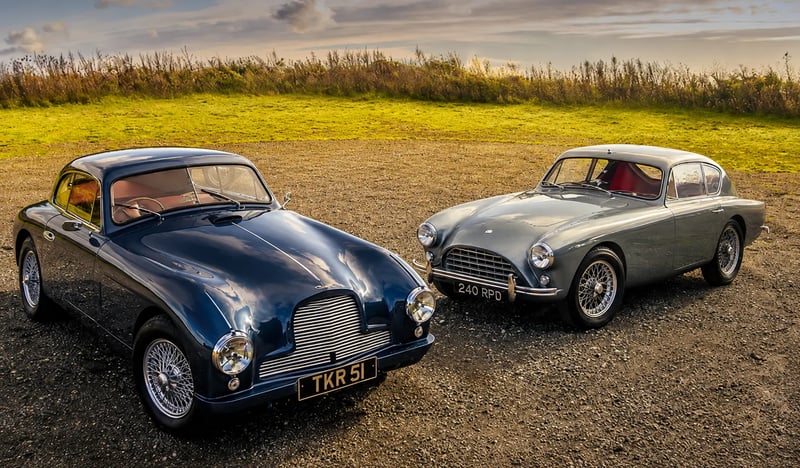
The quickest way to distinguish them is the front. The Aston Martin is the larger, more imposing car, with a taller, more upright front and the evolving Aston grille shape. The Aceca is smaller and more delicate, with AC's simple oval "mouth" grille, a rounded nose, and round headlamps set neatly into the front wings, the barchetta influence of the Ferrari 166 MM clearly present. In profile, the Aston sits higher and longer to accommodate its rear seats, while the Aceca is lower, shorter and more compact, a strict two-seater. Once you have seen the two side by side, you will never mistake them again.
Head to head
| AC Aceca-Bristol | Aston Martin DB2/4 (3-litre) | |
|---|---|---|
| Built | 1954 to 1963 | 1953 to 1957 |
| Body | Steel tube and aluminium, ash in doors and hatch, 2-seat coupé | Aluminium over steel frame, 2+2 coupé |
| Engine | 1,971 cc Bristol straight-six | 2,922 cc Lagonda twin-cam straight-six |
| Valvetrain | Pushrod (cross-pushrod "faux twin-cam") | Twin overhead camshafts |
| Power | ~105 to 128 bhp | ~140 bhp (up to 165 in Mk II) |
| Top speed | ~116 to 128 mph | ~118 to 120 mph |
| 0-60 mph | ~9 sec | ~10.5 sec |
| Weight | ~960 kg | ~1,270 kg |
| Seats | 2 | 2+2 |
| Total built | 328 Acecas (169 Bristol) | ~764 DB2/4 (Mk I & II) |
Figures are period-typical and vary between individual cars and sources. The original AC-engined Aceca produced around 90 bhp; the Bristol car is compared here as the closest performance match.
The engines
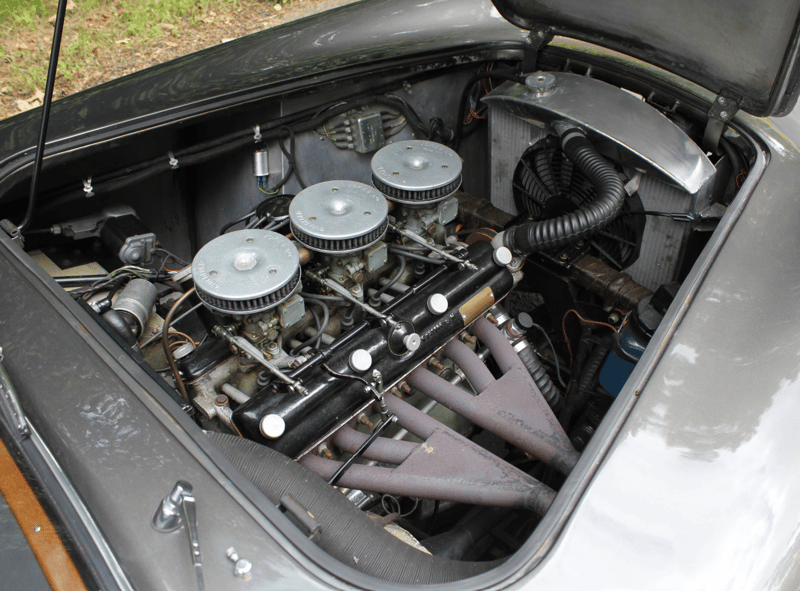
Here the two philosophies are clearest. The Aston's Lagonda six was a genuine twin-overhead-camshaft design with real racing ancestry, designed under W. O. Bentley at Lagonda, sophisticated, powerful and befitting the marque. The Aceca's engines took a different route to a similar end. The original AC Light Six was a charming but elderly design dating to 1919; the Bristol unit that transformed the car was, famously, a pushrod engine so cleverly built, with its exhaust valves worked by transverse pushrods, that it looked like a twin-cam while costing far less to make. The Aston wore its engineering openly; the Bristol hid its cleverness in plain sight.
On the road
Both are rewarding, but in different registers. The heavier Aston is the more relaxed, more powerful grand tourer, with the muscle and the refinement for effortless long-distance travel two-up, or four at a push. The lighter Aceca is the more agile and communicative car, its low weight and near-perfect balance giving it a delicacy and a feel through corners that the bigger Aston cannot quite match, at the cost of outright pace in AC-engined form and the practicality of those rear seats. In Bristol trim, the Aceca closes the performance gap almost entirely while keeping its lightness.
Rarity and production
The Aceca is by far the rarer car. Just 328 were made in total, against something over 760 DB2/4s, and rarer still if you count only the 169 Aceca-Bristols. Both cars have hand-built coachwork, but differ in size, seating and construction.
“The Aston is the grander car. The Aceca is the rarer, lighter, and, to these eyes, more delicate one.”
The verdict
So which is the better car? Honestly, neither, and that is the fair answer, not a diplomatic one. The two set out to do different things, each does its own thing superbly, and so the "better" car is simply the one that matches what you want from it.
Choose the Aston Martin DB2/4 if your ideal is the grander, more powerful grand tourer: a genuine twin-cam six, the muscle and refinement for effortless long-distance touring, occasional rear seats for real 2+2 flexibility, and the prestige and blue-chip provenance of the David Brown-era marque. It is a magnificent, milestone car, the one that gave the world the hatchback, and if that is the story you want to own, nothing about the Aceca need change your mind.
Choose the AC Aceca-Bristol if your ideal is the lighter, purer sporting coupé: a jewel-like, race-bred engine, exceptional delicacy and balance, a strict two-seat cockpit, far greater rarity, and a direct bloodline to the AC Cobra. It trades grandeur and space for agility and intimacy, and rewards you with a car that feels alive in a way the bigger Aston does not.
Neither choice is wrong, because they answer different questions. One buyer wants a distinguished grand tourer to cover continents in comfort; another wants a featherweight thoroughbred to thread down a mountain road. Both are among the finest British coupés of their age, and the right one is simply the car whose character, and whose story, is the one you want to tell.

About the author
A lifelong classic-car enthusiast in North Yorkshire, near Thornton-le-Dale, who owns and maintains an AC Aceca, writing the single-model reference he always wished existed. Read the full bio.